





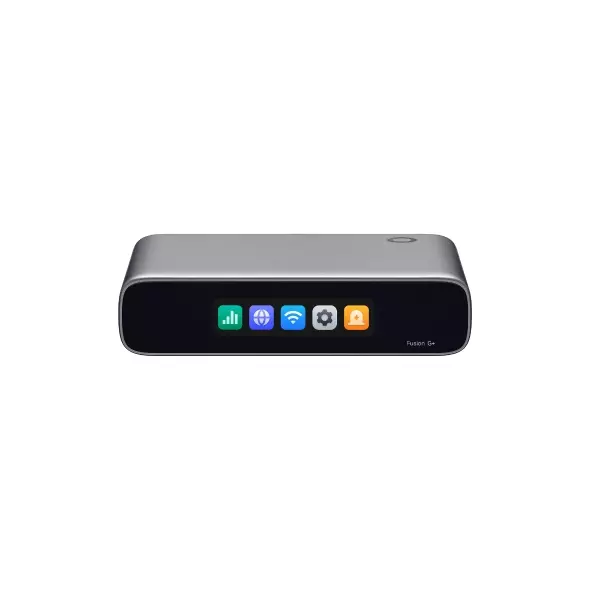
Omada Fusion G+…
Original price was: 457 ₼.413 ₼Current price is: 413 ₼.
Original price was: 457 ₼.413 ₼Current price is: 413 ₼.

Original price was: 345 ₼.313 ₼Current price is: 313 ₼.

Original price was: 425 ₼.385 ₼Current price is: 385 ₼.

Original price was: 1013 ₼.917 ₼Current price is: 917 ₼.

Original price was: 2840 ₼.2570 ₼Current price is: 2570 ₼.
Omada controllers are what turns separate routers, switches and access points into one managed network. From a single interface you configure every device, push firmware updates, set up guest portals and VLANs, and watch who is connected and how much traffic they use.
There are three forms. The software controller is free and runs on a PC or server. A hardware controller (OC200, OC300) is a small always-on box that keeps the network under management without a dedicated computer. The cloud controller manages several sites from anywhere, which suits companies with branches.
Devices keep working even if the controller goes offline — it manages, it does not carry traffic. Tell us the number of devices and sites and we will say which option fits. We are the official TP-Link partner in Azerbaijan.
Omada is TP-Link's business networking ecosystem. What sets it apart from an ordinary home router is that access points, switches and the gateway are managed from a single controller. You see every access point in one place, run one Wi-Fi network across the whole building, open a guest network and fix problems remotely. It suits offices, cafés, hotels, warehouses and schools.
A working estimate: one EAP covers roughly 80–120 m² of open office space, or 25–50 active users. In an office with partitions and separate rooms the density goes up — every wall weakens the signal. In warehouses and production halls metal racking reflects the signal strongly, so access points are placed closer together.
| Model | Mounting | Standard | Best for |
|---|---|---|---|
| EAP620 HD | Ceiling | Wi-Fi 6 (AX1800) | Offices and cafés — dense, device-heavy environments |
| EAP723 | Ceiling | Wi-Fi 7 | New offices with high speed requirements |
| EAP727 | Ceiling | Wi-Fi 7 | Large areas, maximum throughput |
| EAP725-Outdoor | Outdoor | Wi-Fi 7 | Yards, terraces, warehouse grounds, car parks |
| EAP100-Bridge KIT | Point to point | Wireless bridge | When no cable can be run between two buildings |
There are three options and all give the same interface. Omada Cloud is free, needs no extra hardware and is managed from a browser — the simplest start for smaller sites. Software Controller installs on a computer or server and needs no licence. A hardware controller such as the OC220 is a standalone device that runs continuously — the most dependable choice when there is no server on site. One important point: even if the controller fails, the access points keep serving clients — the controller is only for management.
Access points do not need their own sockets: a PoE switch carries power over the network cable. If you already have a non-PoE switch, a PoE injector (POE10R, POE260R and similar) does the job. Cat5e/Cat6 cabling has to be run through the building — that is the main part of the project and is quoted during installation.
No. Omada cloud management is free — there is no licence and no monthly fee.
An ordinary router is a single device and starts to struggle past 20–30 users. With Omada you extend coverage by adding access points, the connection survives moving between rooms, and the whole network is managed from one panel.
Yes. Access points connect to your current switch and are adopted by the controller. There is no need to replace everything at once.
Yes — a separate guest network, password or portal login, speed limits and blocked access to the internal network are all standard features.
Yes. In Baku we survey the site, calculate how many access points are needed and carry out the installation — get in touch.
Router and mesh setup, ISP configuration and a Wi-Fi survey — from 25 ₼. Free site visit and quote in Baku, six months warranty.
Wi-Fi installation service →
